A brief description of the nature of time from a mythological perspective

We refer to those timeless myths in which heroic mythical beings took up the fight, in order to bring justice, against those who sought to establish on Earth a destructive form of spiritual despotism—corrupted both materially and in substance—that threatened to upset the balance of the forces of light and darkness.
The intensity of the conflicts waged between the energies of light and those of darkness has always stemmed from humanity’s excess and egocentricity in its unbearable, insatiable, and yet self-destructive craving for material wealth, worldly recognition, and an insatiable desire for power and dominance over others. Factors from which, since the dawn of humanity on Earth, those beings have fed—and continue to feed—who seemed to have been eradicated by the heroes:
The mythical bull Paris (Minotaur), re-energized in the current cycle of the Earth’s rotation by human wickedness and greed, may consider himself on the ropes once again, despite his apparent invulnerability and infallibility. Courageous warriors of the light are once again rising up against his restless, predatory, deadly, and anti-light bull-like nature, just as the Greeks once fought against the raging and spreading bull cult, from which—to put it simply! —the Moloch cult that reigns today, which is constantly fueled by the negative energies of humanity.
Heracles, too—as should be recalled in the mythological context—wrestled down the fire-breathing half-man Cacus of Italy, who (figuratively—symbolically) has reawakened in the context of the Moloch cult as a country-specific manifestation and shows signs of life in the once again active Italian volcanic mountains (including Vesuvius) and landscapes (e.g., the Campi Flegrei—Phlegraean Fields). Cacus is wading through the Tiber once more, and his power and cruelty should not be underestimated: on more than one of the bridges spanning the river, one of the human heroes of yore hung lifeless because he resisted the Cacus-Moloch system or simply saw through it.
The proximity of the Tiber to Vatican City is striking, and the statue of Moloch (Cacus) prominently placed at the front of St. Peter’s Basilica still bears witness to the fact that the spiritual—religious systems based on earthly ideas—is intertwined with secular power. Devout Christians and tourists who visit the smallest state on earth, often in anticipation of a glimmer of religious hope, may participate in this connection to the extent that they are allowed to purchase a small figurine of (Cacus)-Moloch from the ever-enterprising Vatican… Unbeknownst to them, they have bought into another Moloch-like energy system, with all its future implications, into their living environment.
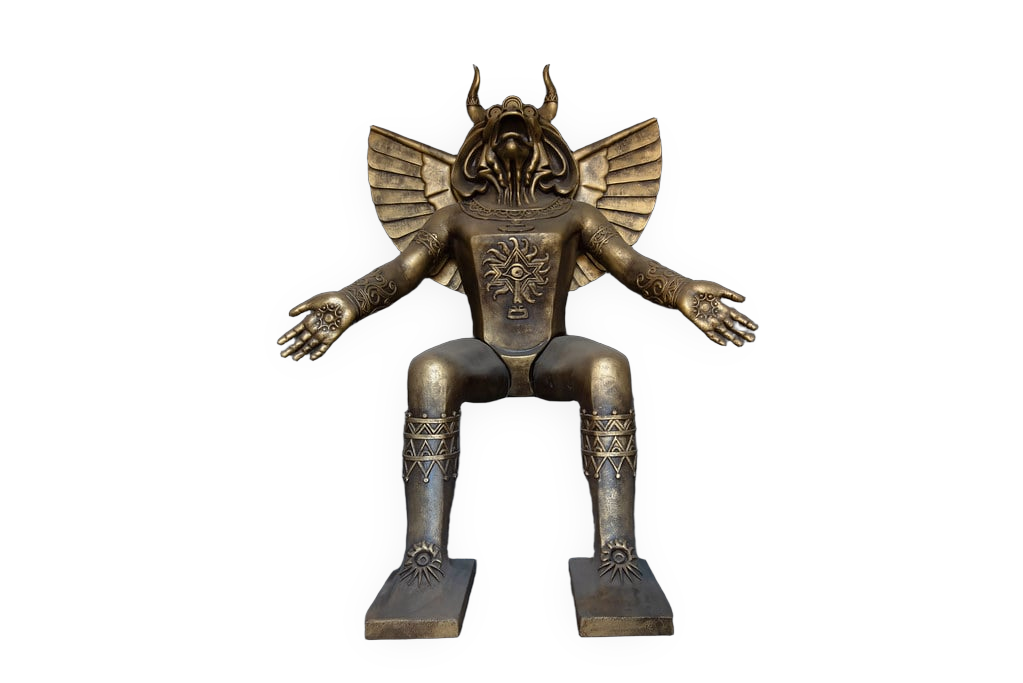
Statue of Moloch (Cacus) at the front of St. Peter’s Basilica (Rome)
Currently, wars, conflicts, and resistance against the political systems supporting the Moloch system are flaring up worldwide. In our blog post (Hollywood, France … Germany), we outlined the dangers posed by the Moloch system and explained that they will not relinquish the positions they hold in politics, the economy, the military, the police, the elite-oriented judiciary designed to control ordinary people, the media, etc., without a fight. Their crude goals were carved into the Georgia Guidestones for all to see and read, and the implementation of the carved paragraphs is omnipresent, palpable, and visible.
When viewed through a mythological lens, it becomes clear that the question is not whether one or the other driving force behind the conflict is positive, negative, or even justified. The outcome of the process, however painful it may be for the individual or the collective, is intended to be that those affected, due to the negative circumstances acting upon them—which they must examine and evaluate—can be elevated to a higher level of consciousness.
In the secular belief system, there is the assertion that humanity can learn lessons from history. The only essence that can be extracted from this statement, despite all efforts, is the realization that the struggle of man against man, states against states, etc., is based solely on decisions made by the self-appointed Moloch-like elite. What we cannot filter out from a purely secular view of history, however, is the mythological aspect that influences all worldly and human events.
Learning from mythology means understanding the struggle of light (spiritual knowledge, action, and life) against darkness (materialism, dehumanization, transhumanism, elitist power structures, etc.) and committing oneself as a champion of the abundance of light.
This earth-bound process of transformation described above can be transferred into the realm of the absurd or the irrational in order to avoid having to confront the reality of the constant process of change. Likewise, it is misguided to deny the myths that continue to influence the present day simply because they are situated far in the past on the timeline of the world’s existence.
If we break down the spheres of influence of the myths onto the present-day timeline, the myths show us that the battle of light against darkness has been waged since the beginning of time and will continue to repeat itself until the battle is decided.