The Moloch System’s Reach for the Sun and Orbit—The Fall of Modernity’s Icarus—Part 1

A Brief Introduction
In this first part of the blog article, we outline the Moloch system’s growing interest in the use of solar energy and outer space from a secular perspective.
In Part 2 of this blog post, which will be published shortly, we will examine the relationship between the cosmos, the sun, and humanity, incorporating spiritual aspects.
Humanity’s quest for the sun’s energy—even in a spiritual sense—is as old as humanity itself. The tale of the mythical figure Icarus, who flew too close to the sun’s power, serves as a constant reminder that improper, self-centered handling will have negative consequences. And yet, in its thirst for research, in its thinking and actions, modernity is driven by the belief that it is superior to the original act of creation. The fact that this arrogance leads to the crossing of clearly defined boundaries—such as altering the genome or manipulating the weather—without considering the consequences borders on excess. But what drives humans to feel they need not abide by the primordial rules? On the one hand, the greed for material wealth or economic power must be considered and evaluated; and on the other hand, the desire of those who rule the world to have a means at their disposal to massively intervene in and control the living environment of those who do not belong to the ruling class—going so far as to drastically reduce the human population in order to replace it with controllable, submissive transhumanist beings.
Tapping into the Sun’s Energy Fields
“Reflect Orbital,” a California-based startup, plans to fill orbit with 50,000 satellites equipped with mirrors up to 15 meters in diameter to direct sunlight captured at night—for a fee, of course! —for example, onto agricultural land—to enable plant growth 24 hours a day. Behind this potential application, one might suspect a humanistic motive on the part of the initiators of this “fabulous” but not-so-new mirror idea—such as the desire to ensure food for the ever-growing world population—which is a thorn in the side of the so-called global elite. But the potential applications of these light mirrors don’t end there: Wouldn’t it be nice to lie on the beach at three in the morning while the (actually despised and to be combated!) blazing sun tans your body? A soccer stadium could also become a place of entertainment and sports at night thanks to sunlight reflected from space—and all of this would certainly help save a great deal of harmful fossil fuels. Taking this idea further, one might think that cities shrouded in night, bathed in the light of this ingenious sunlight-reflection concept, could at least curb those negative human criminal tendencies that flourish at night.
In addition to the aforementioned—in the view of this project’s initiators—everyday benefits of irradiating the Earth, which is always only partially shrouded in darkness at night, certain aspects related to AI technology and the fundamental transformation of the Earth come to the fore: For one thing, AI technology requires vast amounts of energy: The sunlight reflected from orbit could selectively illuminate solar farms (on land once used for agriculture!) to harness this solar energy, which, once converted into electricity, could be used for AI data centers. However, another aspect seems important to us in the context of this project: Increasing robotization: To replace the masses of people (still) needed as a labor force (a goal toward which intense efforts are being directed), hundreds of thousands of AI-controlled robots will be required. These robots are designed to perform tasks day and night in a mindless, dehumanized manner—a process that, however, requires a constant flow of energy, which must be stored by the batteries built into the robots. The lighting concept of “24-hour sun” would be quite helpful in this regard.
The U.S. Federal Communications Commission (FCC) has already given the green light to this proposal to commercialize space: “Reflect Orbital” plans to deploy 50,000 satellites into space by the end of the project.
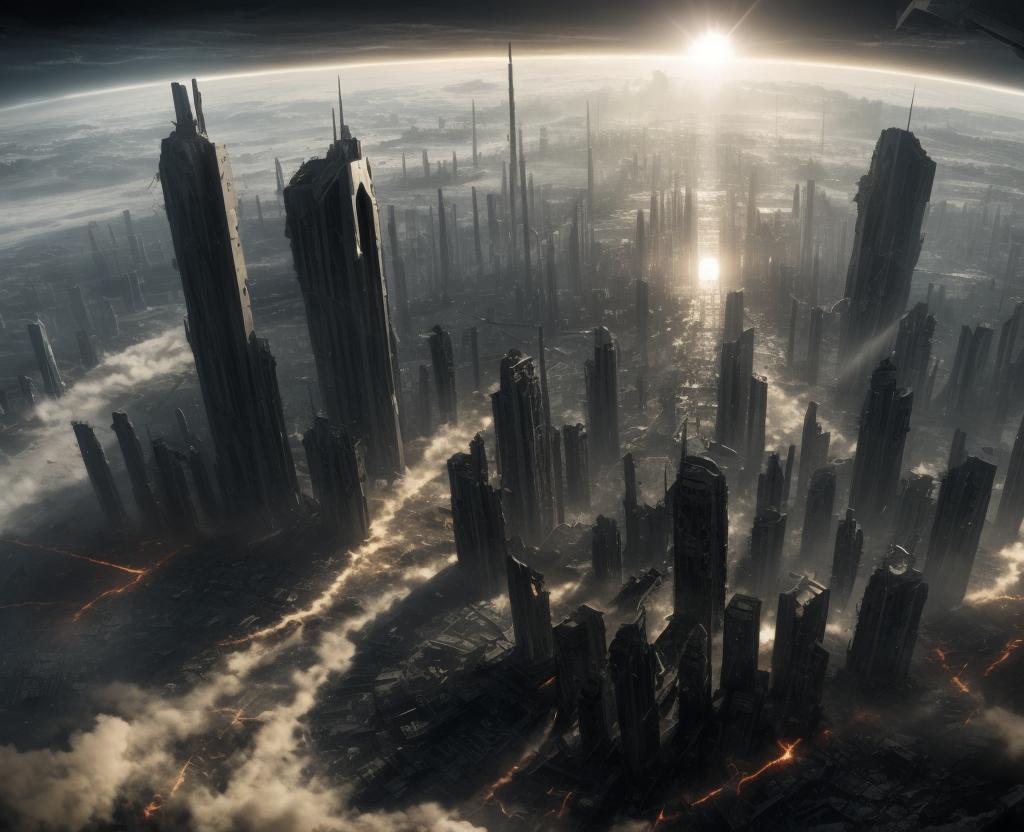
If you, dear reader, imagine the scenarios mentioned above as belonging to the realm of utopia, we’re afraid we’ll have to disappoint you, because “Reflect Orbital” will launch its first satellite into space as early as 2026, where it can join the tens of thousands of other satellites dedicated to its mission of controlling or destroying humanity—the U.S. Federal Communications Commission (FCC) has already given the green light to this plan to commercialize the sky: 50,000 satellites “Reflect Orbital” aims to station in space by the end of the project to bring happiness to humanity—and to ensure ample profits.
Incidentally, these noble intentions to bring happiness to humanity are not new. In the mid-1980s, Russian engineer Vladimir Syromyatnikov conceived a kind of solar sail to harness the sun’s light to power spacecraft. In 1988, the Soviet government took up Syromyatnikov’s original plan with the goal of using sunlight to increase productivity in the low-light northern regions of the Soviet Union.
In October 1992, the Soviet Union launched the first mirror satellite, “Znamya 2,” into space, which created a 5-km-wide strip of light stretching from southern France to western Russia. Spurred by this success, “Znamya 2.5” was launched into space in 1999, but the satellite burned up before the mirror could even open. Due to the high cost of the project (up to 36 mirrors had been planned), the Soviet Union discontinued the project.
In 1980, the U.S. conducted various planning and field tests through the NASA Ames Research Center. The plan was to position 1,000 mirrors, each with a diameter of 1 km, in space. For whatever reason, NASA terminated the project and handed it over in 1982 to a private company called the “Langley Research Center” (Virginia), which, in turn, commissioned “Astro Research Corp.” to continue the Ames feasibility study; the company developed a corresponding concept that was never implemented.
The Old and the New Archimedes—Playing with War
The old Archimedes had already conceived the idea (though we do not know if it was ever carried out) of repelling the Roman fleet approaching Greece using a mirror that reflected sunlight, with the beams directed at the wooden ships to set them ablaze.

Archimedes is said to have sunk the Roman fleet attacking Greece by reflecting sunlight with a mirror.
In 1945, an article appeared in an issue of Live Magazine that described, with the aid of sketches, how the Third Reich had planned to install a giant solar cannon at an altitude of approximately 88,000 km in order to—of course!—launch attacks on countries around the world. The idea was based on a 1929 proposal by physicist Hermann Oberth (1894–1989), who wanted to place a mirror made of metallic sodium with a diameter of 100 m in space.
Summary
Humanity’s dream of harnessing the sun as an energy source may serve a materialistic worldview, but given the premise that the world is governed by Moloch-like energy, it can be assumed that the construction of solar reflectors serves objectives other than those rooted in humanism.
The general public will be presented with the aspects of such an undertaking that are beneficial to humanity: food security, energy supply, lighting for specific regions of the country, etc. However, the technical feasibility of combining the 50,000 satellite mirrors positioned in space by “Reflect Orbital” into a giant sunlight reflector—in order to finally create the solar cannon—will be kept better hidden from the public.
Such a super-sunlight cannon would offer its owners or operators the ability to use concentrated solar radiation against the enemy in a military conflict. But it doesn’t always have to come down to war; it would also be possible to use the solar cannon to gain or expand economic power by destroying agricultural land or drying up water sources, rivers, and lakes—and the destruction of critical infrastructure owned by market competitors would also be within the realm of possibility.
The IKARUS case—a symbol of modernity!

The resurgence of the Moloch-controlled IKARUS, aimed at conquering the sun and orbit in order to exploit their energy fields for harmful purposes, will—as the example of IKARUS shows us—once again end in a catastrophic downfall, to the detriment of all humanity.
(C) 2026 by signs-of-wisdom.com (Team SoW) All Rights Reserved.